Sunday, 21 August 2011

The water reached to Shashkhana village

 The villagers have access to clean drinking water and they have enough clean drinking water and the water to save apple tries from dying.
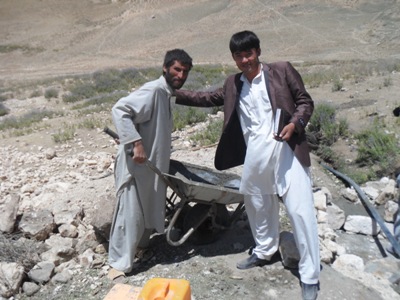
The following pictures shows the villagers were laying pipes


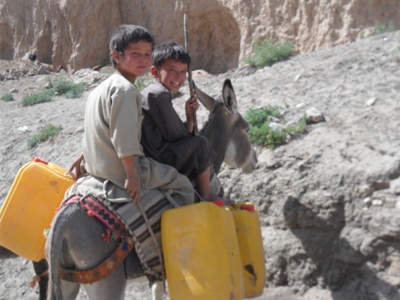
The picture below shows the two children were very happy because the water has reached to their village and were saying ” It was very hard for us to go on the mountain to bring the water specially in summer when the donkey was busy and we had no water for drinking sometimes for weeks. When the piping is finished we will always have access to clean drinking water”.


Friday, 12 August 2011

Another villagein severe need of water

Shahngir is the biggest village in Charkent district, with 300 families.
Only one spring in this village has not dried and this spring does not have
enough water for all the 300 families and their animals.

The weather is hot and it is Ramadon and the Mullah says not to drink any water, the thirsty boy just reached to the water and is drinking water with the bucket. He was relaxed after drinking the water and said “Our home is very far from the spring and we had no water all night”.
The above tow pictures show a man taking water in tubes. He said “I walk one and half hours to get to the water but some times when I came here there is no water and I have to wait four to five hours to get water. If it dries we have to leave our homes and move somewhere else”

The reason ,we as a health organization, are providing water, that it reduces diarrhoea and deaths of children from drinking dirty water. And it also creates much good will for co-operative work with villagers

Work on Water in Shashkhana village

Two Weeks ago I wrote about planning to provide water , now the work on piping is started and after one week it  will be finished and the villagers will have access to clean drinking water.
The above picture shows the men are building a small tank on spring to start piping

The poor villagers in Charkent received Light Units

The poor villagers in Charkent have no access to electricity and they are burning oil for lighting their homes which produces very harmful gases especially in cold winter when all the doors and windows are closed. The accumulation of the harmful gases produced by burning oils causes respiratory and eyes problems especially for children when they are studying in front of the light.
To improve the health of women and children and to improve environment for the women to work (sewing clothes, embroidering) and children to study, we provided each head of the women and men’s village groups with a Low-Cost Solar Light Unit. 

We don't give them money, but they spend a lot of time on this work when they could be growing their crops.
We also have rewarded the Safe Motherhood Groups with the sewing machines and also we are going to reward them the chickens to help them with the livelihoods.


Sunday, 24 July 2011

Villagers in Shashkhan are in sever need for water

The drought has badly affected the district which completely depends on rain water.  Most of the villages in this district have run out of drinking water and are asking the government and NGOs to help them.
I have travelled to the Shashkhana village in Charkent two weeks ago with the head of Men Support Groups (we have established in the village). The villagers had a little reserve of dirty water which was not enough even for drinking.
The village’s water supply

Haider a villager in Shashkhana was saying “ Two of my children got diarrhoea and vomiting last week and we tried herbal medicine first but didn’t help then we took them to Sharshar health centre and got the medicine but now again they have diarrhoea because the water is very dirty”.
He was not the only family suffering from lack of access to clean drinking water but most of the people specially the children are suffering from diarrhoea and vomiting.

The water is a lot and clean at the start, high up in the mountain, 2 Kilometre far from village but it is absorbed and get dirty when reaches to the village.
The spring

As I am a health worker and don’t know much about the water ,so I went to the Balkh Irrigation Department, the local office of Ministry of Agriculture of Afghanistan, and asked for technical help.

The Balkh Irrigation Department agreed to help technically, and then we travelled to the villages and surveyed the springs

After surveying the spring we decided to pipe the water to the village and also to build a tank to reserve the water.
The water will not be used only for drinking and the villagers will also have enough water for their apple trees which is the only fruit in the village.
Qand Agha one of the villagers was saying “ It is three years that I have planted the 7 apple trees and two of them bore fruit and most of them will bear the fruit next year I will lose these apple trees if the water is not piped”
The above picture shows Najmodin the headman of Shashkhana village thumb-printing the contract to provide labour and materials found locally to pipe the water and build a tank

The above two pictures shows we were marking the ground to dig to build the water tank.
I have bought the pipes and send them to the village to finish the work as soon as possible because more of the children are getting diarrhoea and the apple trees are also about to be lost.  

The money I am going to spend on piping the water and building tank in Shashkhana village, are paid by Overseas Aid Commission of Guernsey.
I am very much thankful to Guernsey for paying this money to save the lives of many poor and marginalized people specially the children in my country. 


Friday, 15 July 2011

Saving Lives by Repairing the Autoclave

Last month the hospital’s maternity department asked us to provide a new autoclave to replace one which had broken down. We treated this as an SOS as the department was carrying out about ten operations and thirty deliveries a day with unsterile instruments. We located the manufacturer of the autoclave in China, but they could not provide parts. Meanwhile I located the faulty part in Mazar and found a mechanic to fit it, so saving $1,200 for a new autoclave.


The above two pictures shows the mechanic named Mr. Bashardust repairing the autoclave in Maternity Department in Mazar Hospital.

Thursday, 23 June 2011

The video has been recorded in Qaraghage a remote and drought place in Charkent district Balkh province Afghanistan, with 958 families,  no running water or spring just 3 wells 30 to 40 meter deep that is why they use donkeys to get water out. The wells are located in a village which only can give enough water for 100 families, the other villagers reserves the raining water in winter for use in summer, it is only possible if there is enough raining in winter.
Qaraghage is a place where most of the life depends on raining water the life is good when there is enough raining in winter because the villagers keep enough water for themselves and for domestic animals but the life is worse not only for human but for animals when there is no enough raining in winter because the villagers can’t keep enough water for themselves and also they can’t get any harvest of agriculture.
According to the villagers they don’t remember such a drought like this in their lives and they use the water remained from the previous years and they will only have enough water for drinking for a couple of months then they have to leave their houses and move somewhere to find the water.