Monday, 12 September 2011

Distributing Chickens to the Villagers in Charkent

We aim to improve nutrition and enable women to earn by selling eggs. They don't have any money but chickens are usually a woman's business and they get the money from eggs.
We had to follow their priority of giving first to poor, widows and disabled.Not all of these are the people we are aiming to help most, but they have all agreed to provide ten chickens each next year for other villagers and those will be mothers with young children. 
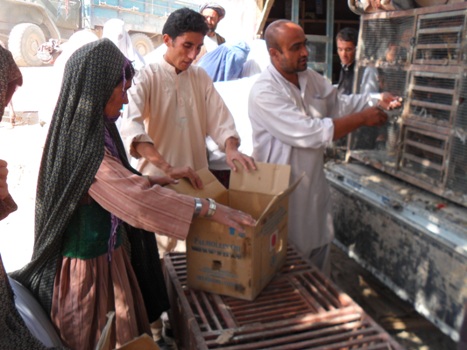
After we trained the women in Poultry Production, helped them to build chicken's houses and gave feeders and drinkers, we distributed the chickes.The Balkh Agriculture Department helped us technically. The following pictures shows when we were distributing Chickens for poors, handicaped and widows.
This picture shows the chickens distribution, from the right the chicken seller, Sayed Arif the animal specialist from Balkh Agriculture, Irrigation and Animal Husbandry department and Zahra the a woman from Shangir village. 
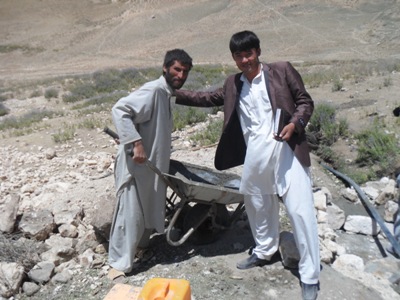
This picture shows a village man on the left with me on the right, receiving the chickens. His name is Adina, he is 48 years old. Adina said "I didn't think that the delivery was so dangerous for my wife, because she has had several deliveries, all at home but she died of severe bleeding after delivery in 30 minutes that we couldn't have time to find a vehicle or donkey to take her to the clinic. The baby also died after two months because there was no one to take care of him". He also said that he had no land of his own and he was working on others land to feed their children but this year he hasn't been able to harvest enough to feed his children.

The following three pictures shows when we were distributing improved food for chickens
We provided each chicken with the improved food for two month, it is the time then the chickens can eat the food found locally.  


Sunday, 21 August 2011

Training Village Women in Poultry Production

To improve the women and children’s health by nutritious foods and to make the women somehow financially independent with a role in decision making, we are going to provide poor and handicapped women and widows in the villages with chickens.

The picture below shows the women in Poultry Production Training in Sharshar, they were trained by a trainer from Balkh Agriculture Department. The women were drawing pictures of chicken houses, the pictures of selecting proper egges for breeding and all the training was in pictures.


Since all the village women are illitatrate, so we were training them in poultry production by showing and drawing pictures and working on models.

The picture below shows a model of chicken house that the trainer we hired from Balkh Agriculture Department was showing the women how to make it.


The picture below shows when the trainer was showing village women practically how to make a proper house for chickens.


Villagers dispute over water in Shashkhana village

The pictures below shows the villagers from Yakatal, Karmaglig, Boriabaf and Shashkhana carrying sticks with themselves when they were disputing over the water in Shashkhana villages.


The four villages are getting water from the same spring. I got the head men to thumbprint an agreement to pipe the water in Shashkhana village and other villages would go there for water.  But when the piping was finished the other three villages started dispute and wanted to destroy the tank and pull out the pipes. But Khalil the assistant for the project midiated and asked both sides to sit and talk he has said “If you find that it is bad I will destroy it for you”. Ther reason for this kinds fo disputes has root in the past years of fighting which they have fought in different groups.


The water reached to Shashkhana village

 The villagers have access to clean drinking water and they have enough clean drinking water and the water to save apple tries from dying.
The following pictures shows the villagers were laying pipes


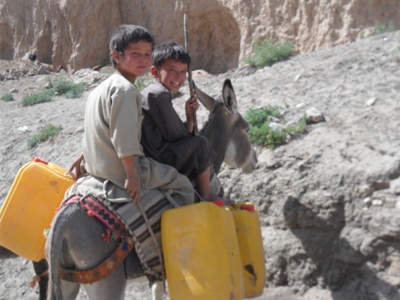
The picture below shows the two children were very happy because the water has reached to their village and were saying ” It was very hard for us to go on the mountain to bring the water specially in summer when the donkey was busy and we had no water for drinking sometimes for weeks. When the piping is finished we will always have access to clean drinking water”.


Friday, 12 August 2011

Another villagein severe need of water

Shahngir is the biggest village in Charkent district, with 300 families.
Only one spring in this village has not dried and this spring does not have
enough water for all the 300 families and their animals.

The weather is hot and it is Ramadon and the Mullah says not to drink any water, the thirsty boy just reached to the water and is drinking water with the bucket. He was relaxed after drinking the water and said “Our home is very far from the spring and we had no water all night”.
The above tow pictures show a man taking water in tubes. He said “I walk one and half hours to get to the water but some times when I came here there is no water and I have to wait four to five hours to get water. If it dries we have to leave our homes and move somewhere else”

The reason ,we as a health organization, are providing water, that it reduces diarrhoea and deaths of children from drinking dirty water. And it also creates much good will for co-operative work with villagers

Work on Water in Shashkhana village

Two Weeks ago I wrote about planning to provide water , now the work on piping is started and after one week it  will be finished and the villagers will have access to clean drinking water.
The above picture shows the men are building a small tank on spring to start piping

The poor villagers in Charkent received Light Units

The poor villagers in Charkent have no access to electricity and they are burning oil for lighting their homes which produces very harmful gases especially in cold winter when all the doors and windows are closed. The accumulation of the harmful gases produced by burning oils causes respiratory and eyes problems especially for children when they are studying in front of the light.
To improve the health of women and children and to improve environment for the women to work (sewing clothes, embroidering) and children to study, we provided each head of the women and men’s village groups with a Low-Cost Solar Light Unit. 

We don't give them money, but they spend a lot of time on this work when they could be growing their crops.
We also have rewarded the Safe Motherhood Groups with the sewing machines and also we are going to reward them the chickens to help them with the livelihoods.